🚀 Scale your Analytics faster: Unveiling the Sisense "Co-Pilot" Stack for Natural Language Ops (NLOps)

⚠️ Experimental Project Notice ⚠️ This is an experimental, community-contributed project from Sisense Field Engineering, shared “as-is.” It is not a GA Sisense feature and is not covered by standard Sisense Customer Support or SLAs. The solution involves third-party components, so start in a low-risk environment, review the security and data-handling notes at the bottom, and validate behavior before broader adoption.
The Agentic Shift in Sisense Environment Management
For years, Sisense has excelled at helping users answer the critical "What" of their data—the insights and analytics. However, as environments scale, the "How" of management—governance, migrations, and schema optimization—has remained a technical, manual task
The Sisense Field Engineering team is excited to introduce the experimental Sisense "Co-Pilot" Stack to help you manage the mundane tasks in Sisense.
Meta-Management: The Operational Distinction
It is crucial to differentiate this stack from the official Sisense AI Assistant. While the native product AI focuses on data analysis (e.g., “What was our revenue last quarter?”), the “Co-Pilot” Stack is specifically engineered for Meta-Management.
It empowers users to manage their Sisense environment with AI-driven autonomy and "as-code" precision. This agent handles the underlying infrastructure, executing tasks like:
- Auditing unused fields
- Migrating dashboards
- Orchestrating complex workflows across different environments.
Shifting the focus from the data in the charts to the operational engine that powers the entire Sisense ecosystem.
🛠️ The Co-Pilot Stack: Three Modular Solutions
The "Co-Pilot" Stack is designed for synergy but is comprised of three independent components. Each module can be utilized as a standalone solution to address specific environmental challenges, depending on your technical requirements:
-
🐍 PySisense SDK: The "As-Code" Co-Pilot
This is an independent, high-performance Python SDK. It enables developers to tackle management complexities through direct scripting, moving beyond manual REST API calls to embrace standardized, repeatable "Platform-as-Code" automation.
- Best for: developers and engineers automating Sisense asset management, programmatic governance, and large-scale environment orchestration via code.
Read the Deep Dive: Mastering Programmable Environment Management ➡️
-
🌐Sisense Meta-Management MCP Server: The Universal Bridge
The Meta-Management MCP Server is a standalone component that sits in front of your Sisense environment. Under the hood, it uses the PySisense SDK to expose environment operations as “AI-ready tools,” so external AI agents like Claude Desktop can run governance, migration, and admin workflows directly—without you having to build a custom user interface.
- Best for: Teams that use a central AI orchestrator to coordinate Sisense operations alongside other enterprise systems and tools.
Read the Deep Dive: Connecting Sisense to the Global AI Ecosystem ➡️
-
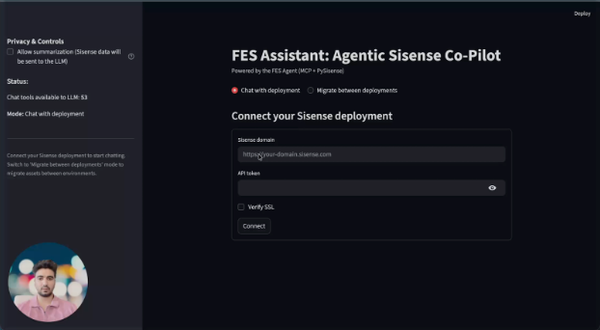
3. 🤖 FES Assistant: The Agentic Sisense Co-Pilot
A full, turnkey AI application that delivers a chatbot-style experience. It brings the SDK and MCP server together into one conversational UI, so you can manage your Sisense environment—build models, migrate assets, and run admin tasks—just by chatting with your AI sidekick.
- Best for: Admins, Data Designers, and Dashboard Designers who want to move fast and automate workflows without writing code.
Read the Deep Dive: Chatting with your Infrastructure ➡️
👥 Empowering Every Persona
The “Co-Pilot” stack is designed for everyone in the Sisense ecosystem, not just administrators:
- 📈 For Dashboard Designers: Locate assets instantly, validate filters and formulas, and run quick environment checks without clicking through menus.
- 🏗️ For Data Designers: Audit models by identifying unused fields, validating joins and M2M relationships, and catching issues early using natural language.
- 🛡️ For Admins: Execute cross-tenant/environment migrations, bulk governance, and ownership/permission changes with built-in safety checks and approval loops.
🤝 Support and Contributing
This is an experimental, community-contributed project maintained by Sisense Field Engineering and provided “as-is” (not a GA Sisense feature).
Support:
- Do not open a GSS ticket. This project is not supported through standard Sisense Customer Support.
- For installation help, usage questions, or issues, contact your Customer Success Manager (CSM). Your CSM will route requests and feedback to the appropriate Field Engineering contact.
- Community users should report bugs via GitHub Issues and include logs plus clear reproduction steps.
Contributing:
- Feature requests and improvements are welcome. Use GitHub Issues to propose ideas and report gaps.
- Submit Pull Requests (PRs) for fixes, enhancements, or documentation updates.
- Share feedback and learnings through the community resources linked above to help guide future iterations.
Appendix: Full Disclaimer and Security Notes
Community-Contributed Tool from Sisense Field Engineering
This project is an experimental tool developed by Sisense Field Engineering to facilitate customer learning and exploration of Sisense capabilities. While maintained by Field Engineering, it is shared "as-is" to encourage feedback and experimentation.
Important Disclaimer: This tool is not part of the core Sisense product release lifecycle and does not undergo the same validation, support, or certification processes as generally available (GA) Sisense features. It is intended to complement, not replace, officially supported Sisense features.
Technical & Security Considerations
Deployment & Execution Control:
- Local SDK Usage (PySisense): All processing logic runs locally on your machine or server. No data is transmitted to Sisense Field Engineering.
- Self-hosted Components (FES Assistant / MCP Server): These components are designed for deployment within your own environment (on-prem or VPC). You maintain complete control over infrastructure, security configuration, access controls, and logs.
Data & LLM Handling:
- LLM Feature Status: The FES Assistant summarization feature is disabled by default.
- Data Transmission: When the summarization feature is enabled, responses retrieved via the Sisense SDK may be sent to your chosen Large Language Model (LLM) provider for processing.
- Third-Party Clients: When using the MCP Server with third-party clients (e.g., IDE agents or desktop assistants like Claude Desktop), data retrieved from Sisense is passed directly to the client’s LLM.
- Customer Responsibility: Customers are responsible for selecting an LLM provider that meets their organization’s data privacy and security requirements.
Recommended Usage Guidelines
To ensure secure and effective use of this experimental tool:
- Environment: Use the tool primarily in sandbox or non-production environments.
- Access: Utilize a dedicated Sisense service account with limited privileges.
- Validation: Thoroughly review and validate the tool's behavior before any broader adoption within your organization.
