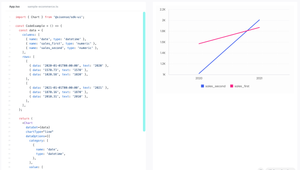
ContributionsMost RecentNewest TopicsMost LikesSolutionsRe: Extract Object Data from the column Hi amitpatil, thanks for your question! Based on the format of your data, it looks like you're not querying directly from a Sisense instance but using an external data source instead. In that case, you'll need to ensure your data is structured appropriately for the Line chart component. Here’s a simple example, assuming you’d like to build a double Line chart (since you have two values per data point) plotted over time: You can use standard JavaScript methods to extract and manipulate data from objects and arrays. Since your column contains objects like `{"sales": [1570.73, 1020.58]}`, you can access the sales data using something like `row.sales` (assuming each row is an object). You might want to look into `map()` to transform your dataset into the required format. Hope this helps! Re: Navigating the Future of Angular: Questions and Insights on the Compose SDK IsaacBlanco, I wanted to follow up on the issues mentioned in this thread. Compose SDK has introduced a new way to provide custom translations, eliminating the need for a translation plugin. You can find more details in the internationalization guide. Additionally, there’s a Jest configuration guide available to help you leverage the CJS builds, which are now included in all packages. Thank you for shaping Compose SDK with us! Re: Navigating the Future of Angular: Questions and Insights on the Compose SDK IsaacBlanco, part of our vision for the Compose SDK is to integrate certain enhancements delivered through Fusion plugins directly into the product. Translations are one area where we see an opportunity to improve the overall user experience. If you could provide more details about your use case—such as which parts of the product you'd like to translate, whether you need dynamic or static translations, etc.—we can consider including this as a feature request in our planning for next year. For more specific discussions, I’ll send you a private message so we can continue the conversation in detail. Re: Navigating the Future of Angular: Questions and Insights on the Compose SDK Hi IsaacBlanco, Thank you for taking the time to share your appreciation for the improvements in the Compose SDK. We're glad to hear that you’re enjoying the performance gains and new features in React, as well as the overall enhancements. Plugins are indeed a significant topic, and we definitely have this in our roadmap. The challenge lies in how most plugins are tightly integrated with Fusion infrastructure and lifecycle, which Compose SDK doesn’t directly access. We’re taking incremental steps to bridge this gap — starting with the ability to register plugins to handle layout gaps when fetching a dashboard. This functionality is already implemented in React, and our next step is to support this in Angular. Since Angular doesn’t provide a straightforward solution to pass a component to be rendered as a single object like React does, we’re developing a custom approach for it. As for supporting all types of plugins, we are still in the discovery phase. We’re carefully assessing how best to approach this and we will be working closely with plugin vendors to ensure that if the need arises to transition existing plugins through Compose SDK, it will be smooth. We’re sorry to hear about the challenges you’ve faced with Jest and Compose SKD for Angular. We work to resolve compatibility issues with external technologies based on developer needs and usage, and we’ll definitely look into this further as we now have your feedback. Your experience with manually mocking components sounds like a pain point we need to address. If you could share more details or examples from your projects, it would help us dive deeper into the root cause and come up with a solution. We’re glad to hear you've noticed improvements in performance, particularly with reduced build times. Performance optimization is an ongoing priority for us. I’ll make sure to include your feedback in our initiative, with a specific focus on Angular to address the heavy dependencies you mentioned. Thank you once again for your valuable feedback and for helping us shape our future efforts. We’re committed to delivering a seamless developer experience, and input like yours is instrumental in guiding our roadmap. Looking forward to hearing more from you, and we appreciate your continued support of the Compose SDK! Re: How to create the data model without using sisense cli in my application using compose sdk To address your API request specifically, `sdk-cli` package uses `/api/datasources/<datasource_name>/fields/search` endpoint to grab initial datasource information which is then converted to attributes: https://github.com/sisense/compose-sdk-monorepo/blob/main/packages/sdk-query-client/src/query-api-dispatcher/query-api-dispatcher.ts#L26 Note: using this endpoint will not give the final result as `sdk-cli` will, some additional code transformations will be required. `createAttribute` mentioned earlier is one of the tools that would help